Trajectory Optimization for Spot-Welding Robots
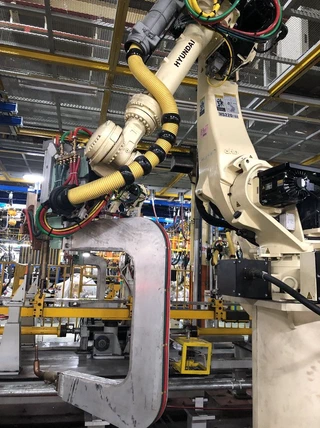 Spot-welding robots on an automotive body-production line
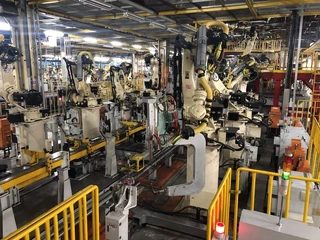
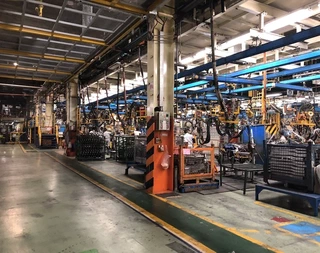
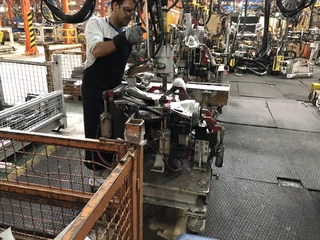
For my M.Sc. thesis, I collaborated with an automobile manufacturing company to optimize the motion of the robots that perform spot welding on the vehicle-body production line.
The Problem
On a car-body assembly line, many serial robots perform hundreds of spot welds. Their trajectories were programmed manually by operators — reliable, but far from optimal in speed and energy use.
What I Did
I formulated the robot’s motion as an optimization problem and solved it two ways:
- Minimum-time trajectory — a single-objective problem minimizing the welding gun’s travel time.
- Time–energy trajectory — a multi-objective problem minimizing both travel time and energy consumption.
The planning considered the position and orientation of the welding gun simultaneously, in both joint and Cartesian spaces, while respecting the robot’s joint limits and the required gun orientation at each weld point. I used genetic algorithm and particle swarm optimization to search for the best trajectories.
Results
Applied to a real robot on the production line, the optimized trajectories reduced the spot-welding operation’s travel time by:
- up to 24% for the minimum-time trajectory
- up to 11% for the multi-objective (time + energy) trajectory
This work was published in the International Journal of Robotics and Automation (2023) — see the journal article.
compared with the manually programmed trajectories in use.