Real-Time Foot Height Estimation and Activity Classification Using a Foot-Mounted IMU Implemented on a Smartphone

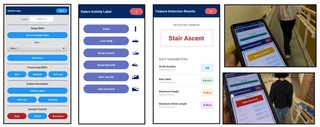 Real-time foot height estimation from a foot-mounted IMU
Why it matters
Tripping is a leading cause of falls, and it is closely tied to how high we lift our feet while walking. Measuring foot clearance continuously, out in daily life, could flag fall risk early — but doing it well with a wearable sensor is hard:
- A single inertial measurement unit (IMU) drifts, so integrated foot height accumulates error over time.
- The usual fix (zero-velocity updates) does not fully remove vertical drift.
- More accurate methods work only offline and do not tell you what activity the person is doing.
What I built
A real-time, single-IMU system that runs entirely on a smartphone — no cloud, no multi-sensor setup. It reconstructs the foot’s height trajectory stride by stride and classifies five locomotion activities (level walking, ramp ascent/descent, stair ascent/descent) at the same time.
Key contributions:
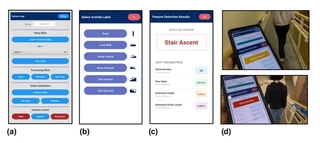
- On-device Android app for stride-by-stride foot-clearance measurement and live activity classification.
- Zero Height Change (ZHC) constraint — a biomechanically grounded correction that cancels cumulative vertical drift at each stride boundary.
- Heel-strike velocity error used as a compact, physically meaningful feature to adaptively pick the right reconstruction model per activity.
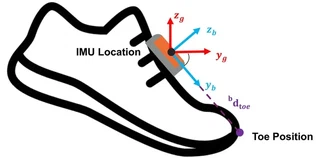
- Toe-height estimation from the IMU pose through a rigid-body transformation, with accuracy comparable to the foot itself.
Validating the height measurement
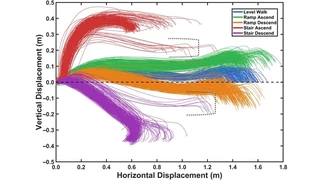
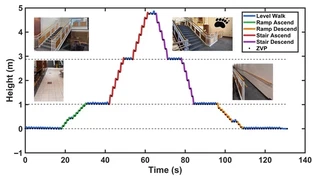
The reconstructed foot trajectories separate cleanly by activity, and the continuous height signal tracks real-world ramps and stairs across a full walking circuit.
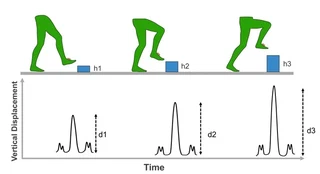
To confirm the system measures real clearance, participants stepped over boxes of known heights and the estimated peak stride height was checked against each obstacle.
Results
- 96.08% overall activity-classification accuracy, with less than one gait cycle of latency.
- Level walking stayed at the ground reference (0.0 cm, 95% CI −1.8 to 1.8 cm).
- Cumulative height error stayed below 1.1 cm across ramp and stair negotiation (mean absolute error 0.42%).
- Toe height was recovered with accuracy comparable to foot height.
Together, this gives a practical foundation for real-time gait feedback and fall-prevention tools that could one day run on the phone already in someone’s pocket.
