The Effects of Real-Time Haptic Feedback on Gait and Cognitive Load in Older Adults

Why it matters
Walking speed is one of the strongest predictors of health and independence in later life, and when it drops the cause is often neuromotor, the timing and coordination of movement, rather than weakness or poor fitness. A key culprit is reduced peak thigh extension (PTE), how far the thigh swings back at the end of each step. If we could cue people to extend the thigh a little more, in real time and out in the world, we could lengthen their stride and speed them up, without a treadmill, a therapist, or a lab.
What I built
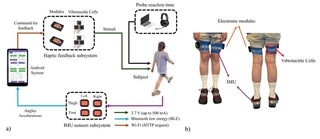
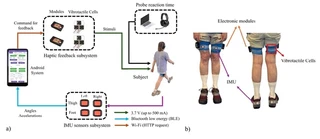
A wearable, smartphone-based haptic feedback system. Two IMUs track the thigh and foot angles, the phone computes PTE stride by stride, and small vibrotactile cells on the thighs deliver a gentle cue when a step needs adjusting.
How the feedback works:
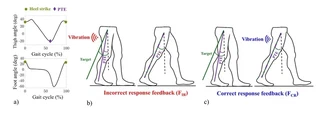
- Each stride’s PTE is compared to a personalized target.
- Two feedback strategies were tested: a cue when the step was incorrect (PTE below target, F_IR) and a cue when the step was correct (target met, F_CR).
- A third group received only verbal instructions (I_V), as a benchmark for the haptic system.
Measuring the mental cost
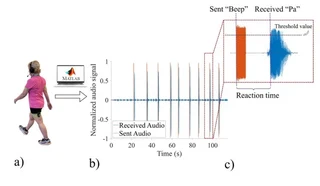
Any gait cue is only useful if people can follow it without concentrating so hard that they stop paying attention to their surroundings. To measure that cognitive load, participants did a probe reaction-time task while walking, responding to audio beeps, with reaction time measured precisely from the sent and received audio.
Results
- +14% stride length and +18% gait speed from a single session with the haptic system.
- Gains were comparable to verbal coaching, but reached through a different mechanism (direct thigh feedback rather than instruction).
- Added cognitive load was small: reaction time rose only 27 ms (F_IR) to 74 ms (F_CR).
- Thirty community-dwelling older adults, averaging about 80 years old.
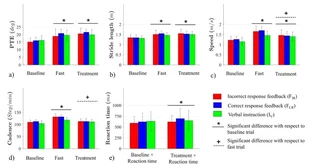
Together this shows that real-time thigh haptics can meaningfully improve older-adult gait in a single session while keeping attentional demand low, a promising, low-cost path toward wearable gait training and fall prevention.
