Trajectory Optimization of a Spot-Welding Robot in the Joint and Cartesian Spaces

Abstract
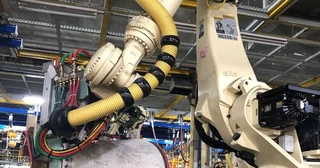
This paper targets the trajectory planning of a serial robot which is used in the spot-welding process of an automobile industry. The problem is first defined based on a single-objective optimization algorithm in which the minimization of travelling time is aimed. Next, a multi-objective optimization problem is defined where the minimization of both the travelling time and energy consumption is demanded. In the proposed methodology, trajectory planning is conducted by considering the position and orientation of the welding gun simultaneously. The corresponding optimization problems are approached by incorporating heuristic methods such as genetic algorithm and particle swarm optimization, and in both the joint and Cartesian spaces. In this regard, the trajectory planning of a real welding robot by considering the most effective parameters is conducted. First, the best space and solution algorithm are identified on the part of the trajectory, and then, the obtained conclusions are used for the remained parts. Results reveal that the obtained trajectories just for a case study robot in the production line can reduce the travelling time of the spot-welding operation up to 24% for the minimum time trajectory and up to 11% for the optimized multi-objective trajectory compared with the current performed trajectory, which is determined manually and non-computationally by human operators.
Type
Publication
International Journal of Robotics and Automation, 38(2), 109-125
Status
Peer-reviewed

Authors
PhD Candidate in Mechanical Engineering
PhD candidate in Mechanical Engineering at the University of Maine. Focused on intelligent wearable systems that combine biomechanics, IMU-based sensing, machine learning, and real-time mobile applications for human movement analysis, gait assessment, activity recognition, and digital health.